Introduction
Gas Chromatography (GC) is one of the most powerful separation techniques available to analytical chemists, and in India's defence and chemical laboratories, it is nothing short of indispensable. From detecting residual solvents in propellant formulations to analysing volatile organic compounds in forensic toxicology casework, GC delivers the resolution, sensitivity, and reproducibility that mission-critical environments demand.
Unlike liquid chromatography, GC is specifically designed for volatile and semi-volatile compounds — making it the technique of choice for explosive residue analysis, petroleum product testing, alcohol and drug quantification, and environmental monitoring of volatile pollutants. For defence establishments, chemical laboratories, and forensic science laboratories (FSLs) across India, the selection of the right GC system directly affects analytical throughput, data reliability, and compliance with regulatory frameworks.
Why Gas Chromatography Is Essential for Defence & Chemical Laboratories
GC's ability to separate complex volatile mixtures with high resolution makes it irreplaceable across several critical domains:
Explosives and Post-Blast Analysis
GC and GC-MS are the primary techniques used in Indian forensic science laboratories for the analysis of explosive residues. Organic explosive compounds such as RDX, TNT, PETN, and HMX are volatile or can be derivatised for GC analysis.
Forensic Toxicology
In forensic toxicology, GC is used for the detection and quantification of:
Alcohols (ethanol, methanol) in blood and tissue samples
Drugs of abuse (amphetamines, cannabinoids, opioids) after derivatisation
Poisons and pesticides (organophosphates, carbamates)
Volatile organic compounds in viscera and biological fluids
Chemical and Petrochemical Analysis
Defence chemical laboratories and public sector undertakings (PSUs) use GC for:
Residual solvent analysis in pharmaceutical and defence-grade chemicals
Petroleum product testing — simulated distillation, PONA analysis, sulphur speciation
Polymer additive analysis — plasticisers, antioxidants, stabilisers
Environmental monitoring — volatile organic compounds (VOCs), BTEX, pesticides
Key Buying Considerations for Defence & Chemical Laboratories
1. Detector Selection: The Most Critical Decision
Flame Ionisation Detector (FID): The universal workhorse for hydrocarbon analysis.
Electron Capture Detector (ECD): Highly selective for halogenated compounds, nitro compounds, and pesticides.
Nitrogen Phosphorus Detector (NPD): Selective for nitrogen- and phosphorus-containing compounds.
Thermal Conductivity Detector (TCD): Universal detector for inorganic gases and permanent gases.
2. Inlet Systems: Split/Splitless and Beyond
Split/Splitless Inlet (SSL): The standard inlet for liquid samples.
Programmable Temperature Vaporising (PTV) Inlet: Offers superior discrimination control.
Headspace Sampler: Essential for volatile compound analysis in solid and liquid matrices.
3. Service Support and AMC in India
Given the critical nature of GC analyses in government and defence laboratories, local service support is non-negotiable. Annual Maintenance Contracts (AMC) are routinely procured for 3–5 years.
Conclusion
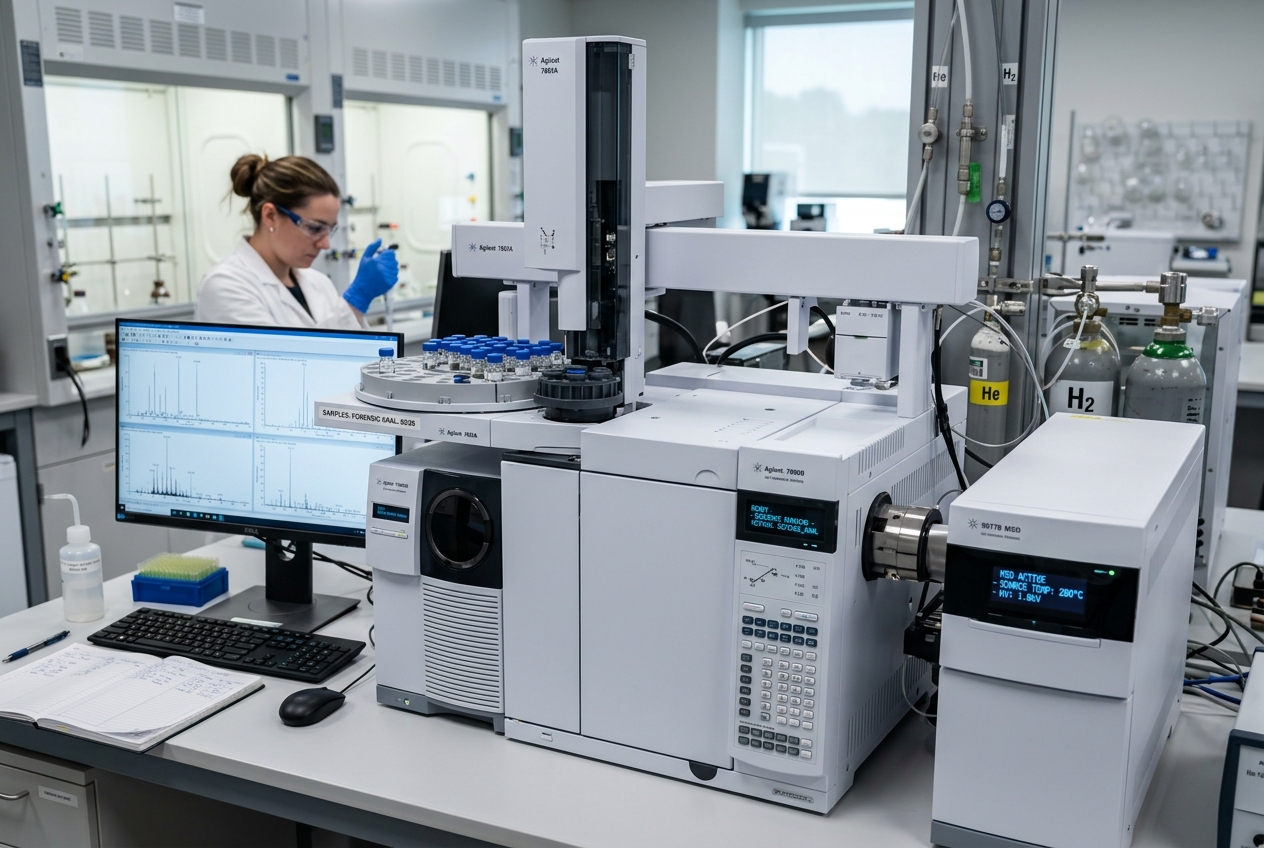
Selecting the right Gas Chromatography system for a defence or chemical laboratory in India requires balancing analytical capability, regulatory compliance, service support, and budget. For most defence and forensic laboratories, a GC system with multiple detectors (FID, ECD, NPD) and a high-capacity autosampler provides the versatility needed for diverse analytical challenges.